








Removable Fretboard Stickers With Musical Indicia
Below is a draft of the original Fret Daddy invention. This is not a legal document. It is for informational purposes only.
FIELD OF THE INVENTION
The present invention relates to the field of teaching aids for stringed instruments.
BACKGROUND
All stringed instruments share a number of common features: sound holes, a sound box, a fretboard or fingerboard, a neck, a nut, a head, tuning pegs, a bridge, and of course strings. In the case of fretted stringed instruments, the fingerboard further contains "frets," which are raised bars that transverse the fingerboard at various intervals parallel to the bottom of the instrument. The challenge of all would-be guitar players is essentially the same: learning to skillfully play various "notes", "chords", "phrases", and "patterns" by manipulating the strings of the instrument of choice.
To play one "note" on a stringed fretted instrument, one must cause one of its many strings to vibrate at one of its possible frequencies or "pitches". To select the pitch and corresponding note to be played, the player depresses the string on the fretboard between two frets, causing the length of the string that is vibrating when plucked to change. When the length of the portion of a given string that is vibrating changes, the frequency of the sound wave emanating also changes which forms the pitch of the note being played. Because each fret is placed at a different length from the bridge pin (the device which holds each string in place), the player can play a variety of notes by depressing the string between different frets before plucking the string.
While learning how to cause strings to vibrate in a manner that is sufficiently pleasing to the ears to pass as "music" may be achieved by a variety of means, a number of common devices are typically employed. Mnemonic devices are often used to teach students the names of sequences of notes and to memorize which notes are needed to form various "chords," which are combinations of various singular notes played at the same time. And visual cues such as fretboard diagrams, are often used to teach students where to place their fingers in order to produce various notes.
Although there are a number of books, videos, and online resources devoted to providing students with visual cues needed to learn the fundamental skills required to learn a stringed instrument, most of these learning aids share a common deficiency: the fretboard patterns, note locations, or chords to be learned are printed on something other than the fretboard of the guitar itself. This forces students to expend a great deal of mental effort in order to figure out how the fretboard patterns, note locations, or chords to be learned, as printed on the visual cue, correspond to the actual instrument being used. The present invention seeks to eliminate this shortcoming by offering students a set of visual cues that can be affixed directly to the surface of the fretboard.
A variety of devices, besides the present invention, have been employed to attempt to affix visual cues directly to the surface of the fretboard. However, all of the devices existing in the prior art have significant shortcomings, making them ineffective or otherwise unattractive to use.
Some devices have a one-piece sheet of pliable material, such as linen, muslin, or aluminum, extending along the length of the fretboard, having fret openings cut throughout the material, which can be secured to the sides of the fretboard using pins. This type of visual cue device, while offering a means to place the lessons to be learned right on the fretboard, is cumbersome and potentially damaging to the instrument. Moreover, because the invention is a one-piece sheet of material, the openings cut throughout the material must be fairly large to accommodate the frets, given that the frets are spaced differently on different types of guitars. This limits the size of printing space. More importantly, because the invention is comprised of one continuous piece of material, the student must either cover the entire fretboard at once or else forgo using the learning device entirely. This is problematic because in some instances it is beneficial for students to deprive themselves of visual cues when unnecessary in order to challenge themselves to allow their brain to do the work otherwise done by the visual cue. Therefore, there are a great number of instances in which it is beneficial to allow student to apply visual cues to some frets but not others.
Other devices have a sheet of autogenously adhesive plastic, such as cling vinyl, on which is printed a series of markers indicating note locations, scales, or chords. These devices are cumbersome to apply, require students to cover the entire fretboard or else forgo using the device entirely, and hamper natural contact between the guitar player's thumb and the back of the guitar neck, since they must cover the entire guitar neck in order to adhere to themselves. This later drawback is significant, since guitar players must constantly slide their thumb up and down the guitar neck in order to play various chords and notes. Thus, these devices threaten optimal playing ability while reinforcing in students' mind and muscle memory incorrect assumptions about the friction levels of the back of the guitar neck.
Other devices have a series of cards which can be alternately placed on the fretboard of the guitar and then withdrawn after the fingers are placed in the proper positions. The lack of permanency of the visual cue requires students to continually stop instrument play to put the relevant card on the fretboard whenever information is needed. This drawback alone is sufficient to make these devices virtually worthless to students trying to learn long musical phrases and complex fretboard patterns.
While a number of other methods and devices have been developed for indicating fretboard patterns, note locations, and chord locations on the surface of the fretboard of stringed instruments, all methods and devices existing in the prior art have significant drawbacks. These methods and devices either require permanent changes to the instrument, interfere with proper play, do not teach note names, must cover the entire fretboard to be used at all, or else embody some other discouraging shortcoming. Accordingly, what is needed is a visual cue learning device that can be temporarily fixed to the fretboard of the guitar, fret-by-fret, without damaging the guitar surface. The present invention meets this need.
SUMMARY OF THE INVENTION
The present invention is comprised of a set of individually removable, low-tack fretboard stickers, which may be adapted for use with all fretted stringed instruments, including but not limited to guitars, bass guitars, banjos, ukuleles, and which may be used to teach students to recognize the locations of notes, fretboard patterns, chords, scales, and other important fundamental musical concepts required to learn to play stringed fretted instruments. The removable fretboard sticker set comprises a set of flat, thin, low-tack or mildly adhesive stickers, with markings of musical indicia printed on them, which indicate musical concepts such as the names and locations of various notes when placed between the appropriate frets of the stringed instrument and the strings of the guitar.
Each sticker in the sticker set may be applied to the surface of the fretboard individually, or in groups or sets, including the entire set and may be removed individually as well. This allows the greatest level of flexibility in designing teaching methods that implement the sticker sets as visual aids.
Each sticker can be individually applied by sliding it underneath the strings of the instrument, aligning the markings directly underneath the strings, and firmly pressing the sticker to the surface of the instrument, causing it to temporarily adhere. The sticker is only wide enough to cover the surface of the fretboard and attach to the sides of the neck, allowing the player of the instrument to make natural contact with the instrument at the back of the neck.
Given recent developments in adhesives technology, there are a number of low-tack adhesives that can be applied to the surface of standard stringed instrument substrates and removed without doing any damage to the surface of the instrument. Such adhesives are incorporated into the preferred embodiment of the present invention, to avoid damaging the instrument's substrate. Depending on the type of adhesive used, the stickers may also be removed and reapplied when needed, allowing them to be repositioned and, in some cases, reused.
The complete sticker set has printed markings on it before being applied to the surface of the instrument. These markers can be used for a variety of purposes. In a preferred embodiment, they may include musical indicia that indicate musical concepts such as the names and locations of notes, the positions of root notes, chords, scales, including, in some cases, notes NOT to be played in various keys or musical modes. The markings may be printed on the stickers in a variety of colors and may contain numbers, alphanumericals in a variety of languages, or any other appropriate type of marking useful in accomplishing the goals of the teaching device. Furthermore, the markings of the stickers may be used in conjunction with sheet music, or other external visual cues, including note names and other helpful information. Furthermore, it is contemplated that the musical indicia of the stickers may communicate musical concepts needed to learn entire songs.
The primary object of the present invention is to create useful low-tack visual devices to aid students in learning the location of various important musical concepts and features on the fretboard of stringed instruments.
A further object of the present invention is to provide a learning device for teaching students of stringed instruments that indicates the location of individual notes to be played in a way that is easily ascertained.
A further object of the present invention is to provide a learning device for teaching students of stringed instruments that is easily applied to and removed from the surface of the chosen instrument.
A further object of the present invention is to provide a learning device for teaching students of stringed instruments that can be adapted to a wide variety of teaching methods, including those requiring fret-by-fret visual cues.
A further object of the present invention is to provide a learning device or system of devices for teaching students of stringed instruments that does not interfere with the natural feel and play of the instrument.
A further object of the present invention is to provide a learning device or system of devices for teaching students of stringed instruments that does not prevent normal contact with the back of the neck of the stringed instrument.
A further object of the present invention is to provide a learning device or system of devices for teaching students of stringed instruments that can be flexibly accommodated to a variety of standard sized instruments.
Other objects, advantages, and novel features of the present invention are set forth in part in the detailed description to follow, taken in conjunction with the accompanying drawings. Further objects, advantages, and novel features may be learned by practice of the invention. The objects and advantages of the present invention may also be realized and attained by means of the appended claims.
Brief Description of Drawings
**Omitted
Detailed Description of the Invention
**Omitted
Claims
**Omitted
ABSTRACT
The present invention is a device and method for teaching note locations, fretboard patterns, scales, and chords on the fingerboard of a fretted stringed instrument ("fretboard"), such as an electric or acoustic guitar. The invention comprises a set of independently affixable fretboard adhesive labels ("stickers") that adhere to the surface of the stringed instrument, using a mild adhesive, so as not to damage the instrument, and a number of markings, which indicate musical indicia. The device is applied to the instrument by slipping the various individual stickers between the corresponding frets and strings of the stringed instrument and affixing the stickers directly to the fretboard.
Popular Products
|
The Fretboard Notemap For Acoustic/Electric Guitar 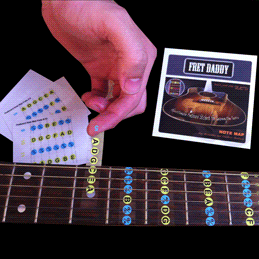 You Pay $9.99 The fretboard notemap is the perfect sticker set for beginners as well as intermediate and advanced players who never learned the names of the notes on the fretboard. Don't worry, you're not alone. The fretboard notemap is our top seller! |
Combo Pack For Acoustic/Electric Guitar  You Pay $24.99 The combination pack includes four sticker sets for the price of two! Master the blues, or use the A major scale or A harmonic minor scale to find new melodic hooks. Need to learn the names of the notes first? Don't worry, the fretboard notemap is included too! |
|---|
Fret Daddy News
|
Fret Daddy Makes Ultimate-guitar Magazine's 2011 Hotlist 
Thousands of amazing new products were featured at NAMM's world-famous trade show in Anaheim this year, but only 20 made it onto Ultimate-Guitar magazine's Hotlist! Fret Daddy is very pleased to have made the cut! Read the article |
Introducing Fret Daddy's A minor/C major Pentatonic Scale  You Pay $9.99 This versatile sticker set is designed to teach guitar players of all levels the A minor/C major Pentatonic scale. Whether you plan on mastering the blues or exploring new hard rock riffs, this essential scale is a must! |
|---|
 Become a fan
 Follow Us
 Send Us Feedback